Fair Divorce Settlement Examples UK: What Fairness Actually Looks Like
Sep 08, 2026
"Fair" is doing a lot of work in that search. What you're really after is something concrete, a number, a ratio, a real shape to compare your own situation against. The honest answer is that there isn't a list of numbers that will tell you what's fair for your marriage. But there are patterns, and understanding them is more useful than any single example would be.
There's No List of Numbers, Only a List of Factors
UK courts don't work from a settlement calculator. They weigh the length of the marriage, both parties' income and earning capacity, the needs of any children, the standard of living during the marriage, and each person's contributions, financial and otherwise. We go through this in full in our post on what you're actually owed in a UK divorce. Any "example" settlement is only useful as far as your marriage matches the factors behind it, not the number itself.
Three Common Shapes a Fair Settlement Takes
Rather than invented examples with invented numbers, here are the patterns that come up again and again in how fairness actually plays out.
- Short marriage, no children, similar incomes. Settlements here tend to sit closer to what each person brought into the marriage and built independently, since there's less need to balance dependency between the two of you going forward.
- Long marriage, one primary earner and one primary carer. This is where splits move furthest from an even divide of "who earned what," because the law recognises raising children and running a home as a contribution equal in weight to a salary. The earner rarely keeps the majority simply for having earned more.
- A business, or self-employed or variable income. These cases usually need a proper valuation of the business or income stream before any settlement can be assessed fairly, and often take longer to resolve because of it. If this is your situation, get a specialist valuation early rather than guessing at what the business is worth.
Notice that none of these produce a single "fair number." They produce a fair process, applied to your specific circumstances.
Why You Won't Find Your Exact Situation in Any List
Every marriage combines these factors differently, and small differences, an inheritance kept separate, one person's health, a short gap in someone's career, shift the outcome. That's exactly why fixating on someone else's settlement, real or invented, tends to do more harm than good. It anchors you to a number that has nothing to do with your actual circumstances.
The stronger approach is understanding the factors well enough that you can judge any offer against them, rather than against a stranger's outcome. Our post on divorce financial settlement in the UK covers the practical side of getting that clarity before any negotiation starts. And if what you're looking at feels like the opposite of fair, our post on is it actually unfair, or does it just feel that way walks through how to tell the difference.
Fair Divorce Settlement Examples UK: Quick Answers
Is there a standard formula for a fair divorce settlement in the UK?
No. Courts weigh a set of factors specific to each marriage rather than applying a fixed formula.
Does the person who earned more always keep more?
No. Non-financial contributions, including raising children and running the home, are weighed equally alongside financial ones.
What happens if one person has a business or self-employed income?
These cases typically require a proper valuation before a fair settlement can be assessed, and often take longer to resolve.
Should I compare my settlement to someone else's?
It's rarely useful. Small differences between marriages change the outcome significantly, so judge an offer against your own circumstances, not someone else's number.
Understand Your Own Factors First
Before you can judge whether an offer is fair, you need a clear picture of your own finances and your own position. The free Divorce Strength masterclass is a good place to start building that clarity.
Know where you stand, and what to do next
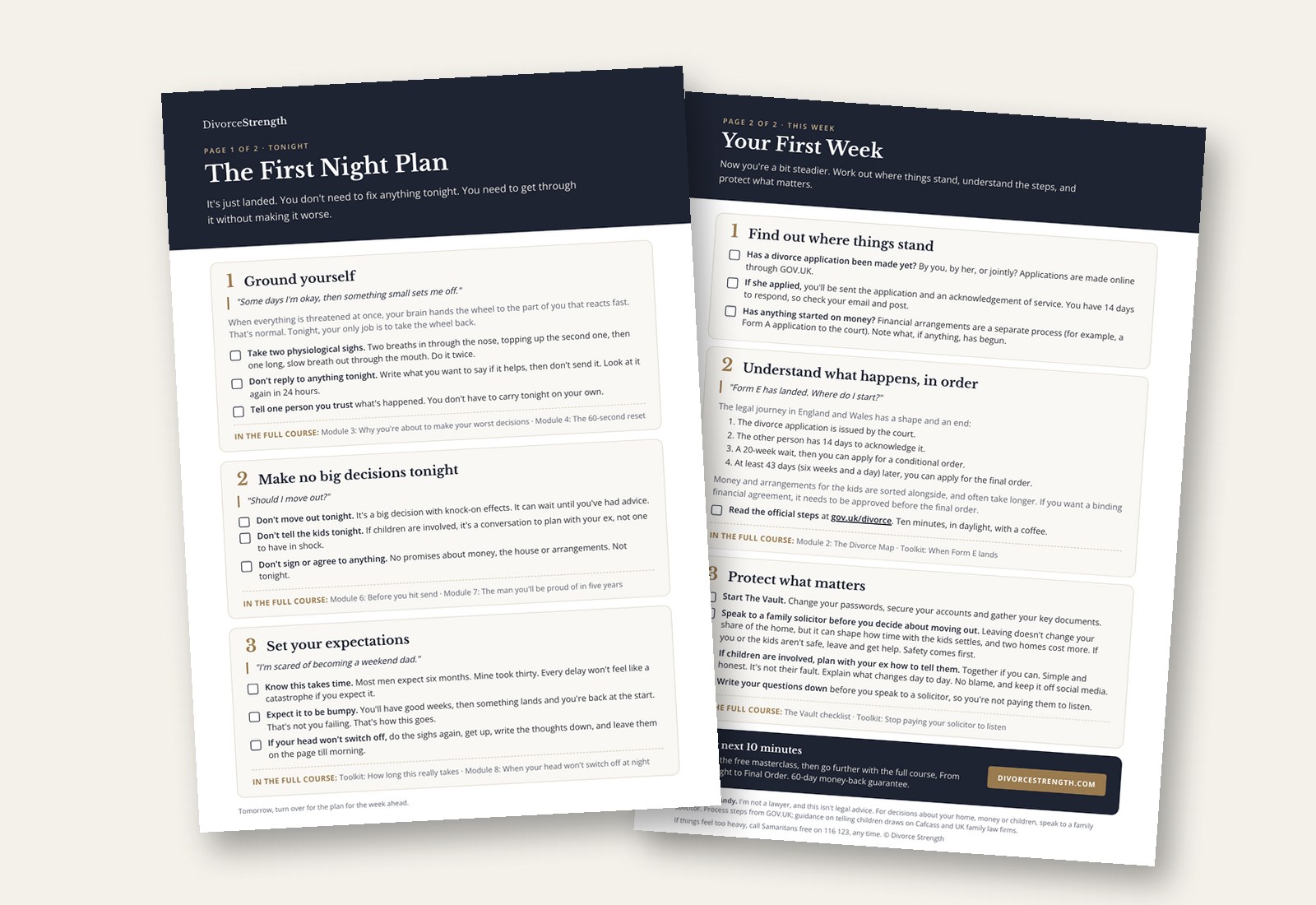
A free two-page plan for men going through divorce. Whether it's just happened or it's been going on for months. Written by a dad who's been through it.
Sent straight to your inbox, plus The Vault checklist the next day. No spam. Just Andy.