My Wife Wants a Divorce: What Should I Do?
Oct 27, 2026My Wife Wants a Divorce: What Should I Do?
She's said it. Maybe you saw it coming. Maybe it came from nowhere. Either way, you're now standing in a situation you weren't prepared for, and the first question in your head is probably some version of: what do I do?
This post is the honest, practical answer to that question. Not a legal lecture. Not generic advice about self-care. What to actually do, roughly in order, in the days and weeks after your wife has told you she wants a divorce.
First: don't do the things that make it worse
Before getting to what you should do, there are a few things that reliably make an already bad situation significantly worse. Most men do at least one of them in the first 48 hours.
Don't agree to anything significant immediately. You're in shock, whether it feels like it or not. Your nervous system is in overdrive. This is one of the worst possible states in which to make decisions that will affect the next years of your life. You do not have to respond to anything right now. Almost nothing is as urgent as it feels.
Don't leave the family home impulsively. Moving out feels like the decent thing to do, especially if there are children and the atmosphere is difficult. But leaving without taking legal advice first can affect your position in ways that are difficult to reverse. Take advice before you go.
Don't make large financial moves. Don't clear joint accounts, cancel joint financial products, or make significant purchases. These actions can damage your legal position and create problems that are expensive to resolve.
Don't put anything in writing you wouldn't want read out in court. Texts, emails, WhatsApp messages. Anger is understandable. Expressing it in writing documents hostility or unreasonable behaviour in a way you will regret. Keep written communication factual, brief, and civil.
Don't use the children as messengers, informants, or emotional support. Whatever is happening between you and your wife, the children need to be protected from it. They should hear a simple, calm, age-appropriate explanation of what's happening — not the full adult reality of it.
What to actually do
1. Get your head into a state where you can think
This is not optional and it is not soft. It's the most practical thing on this list.
When your nervous system is in threat response, the part of your brain responsible for clear, rational thinking goes partially offline. You react rather than decide. You say things you regret. You agree to things you shouldn't. You miss things.
Getting your head regulated enough to think — through sleep, physical movement, limiting alcohol, finding someone to talk to — is the foundation everything else rests on. The financial and legal decisions you make in the coming weeks are permanent. Make them from the best possible headspace you can manage.
Our post on the emotions of a man going through divorce explains what's happening to you right now and why it affects your decision-making. Worth reading.
2. Get a picture of your financial position
Before any conversations about money happen, you need to know what there is. Both parties will be required to provide full financial disclosure as part of divorce proceedings. But you need your own understanding first, independent of what's presented to you.
Start pulling together: all assets (property, savings, investments, vehicles, valuables), all debts (mortgages, loans, credit cards, anything in joint names), and both pension valuations. The pension is often the biggest asset in a marriage and the most commonly overlooked one. Get a valuation from your pension provider before anything else moves.
3. Take legal advice, early
An initial consultation with a family solicitor is not a declaration of war. It's information. You are entitled to understand what your legal position is before you make any decisions.
You don't have to be the one to file. You don't have to instruct a solicitor to conduct full proceedings immediately. But you do need to understand the landscape before you navigate it.
Find a qualified family solicitor at gov.uk/find-a-legal-adviser, or through Resolution at resolution.org.uk, which lists solicitors committed to non-adversarial approaches.
Our post on men's legal rights in divorce in the UK gives a clear overview of the legal framework — including what the law actually says about financial settlements and children's arrangements — before you're sitting opposite a solicitor.
4. Think carefully about your children
If you have children, the arrangements for them need careful thought. Not in the sense of strategy or positioning, but genuine consideration of what you want your relationship with your children to look like.
Informal arrangements made early have a way of becoming the de facto baseline. What you agree to in the first weeks, even informally, tends to shape what happens later. Think about what you actually want before it's implicitly decided by default.
The most important thing is to stay present and engaged. Consistent, reliable contact matters more than any specific arrangement. Don't retreat from your children because the situation is painful. Show up.
5. Tell one or two people you trust
Not to process endlessly. Not to get advice. Just to not go through the first phase of this entirely alone.
Isolation in the early weeks of separation is one of the significant risk factors for men's mental health. It doesn't have to be a close friend. A brother, a colleague, anyone who knows what's happening and who you can be honest with when you need to be.
What this period is actually for
The first weeks after your wife says she wants a divorce feel like a crisis to be managed. And they are, in some ways.
But they're also the period in which you lay down the foundations for everything that follows. The financial decisions, the children's arrangements, the legal proceedings — all of it goes better or worse depending on what you do in these early weeks.
The men who come through divorce intact — who maintain their relationship with their children and their sense of themselves — are not the ones who got lucky or who had more money for better solicitors. They're the ones who got grounded early, understood what was happening to them, and moved through it with some deliberateness rather than just reacting.
That's what the Divorce Strength framework is built for. Not to tell you it'll be fine. To give you the map that makes it navigable.
Read our guide on preparing for divorce as a man for the full picture of what to do in these early weeks.
The free masterclass is 45 minutes covering the psychological and practical foundations every man needs before the big decisions get made.
Watch the free Divorce Strength masterclass here.
You don't have to figure this out alone. And you don't have to figure it out right now. But you do need a map.
If you are struggling and need immediate support, please contact the Samaritans on 116 123 or visit samaritans.org.
Know where you stand, and what to do next
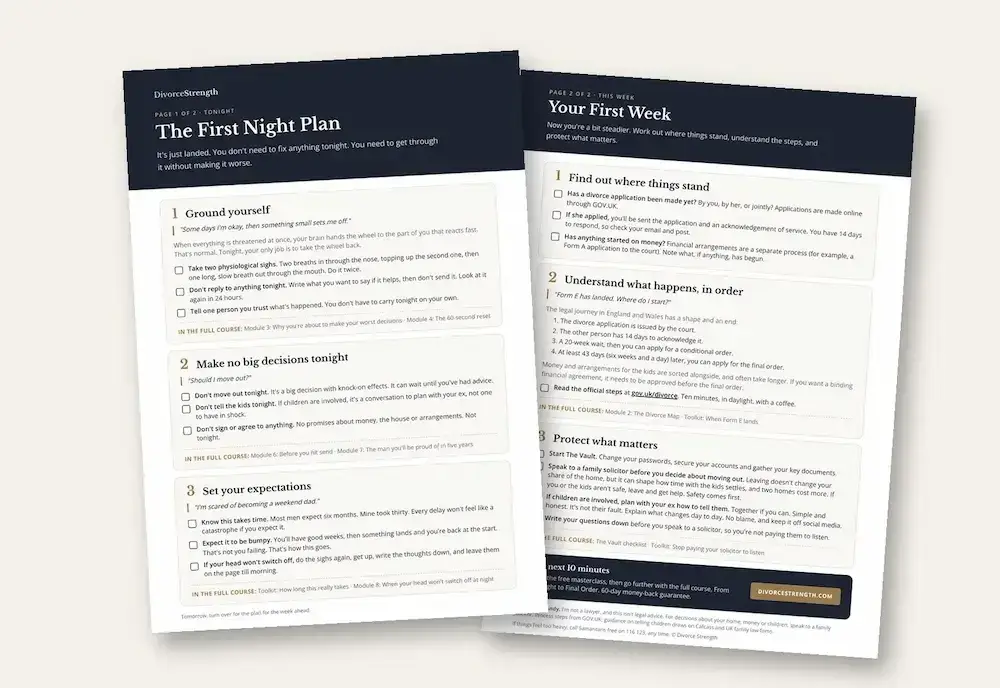
A free two-page plan for men going through divorce. Whether it's just happened or it's been going on for months. Written by a dad who's been through it.
Sent straight to your inbox, plus The Vault checklist the next day. No spam. Just Andy.